0%

Table of Contents

You know, lately everyone's talking about prefabrication. Off-site construction, modular everything… It’s not new, not really, we’ve been messing with pre-fab for decades. But the pressure’s on now, right? Labor shortages, timelines shrinking… Honestly, everyone's scrambling. And a big part of that? Sealed manhole covers. Sounds boring, I know, but get this wrong, and you're looking at a major headache. Believe me, I've seen it.

It’s funny, you spend years perfecting a design in the office, run all the simulations, and then you get on site and… reality hits. Have you noticed how engineers love their perfect spheres and smooth surfaces? Those look great on CAD, but try getting a 50kg cover to seat properly when the frame’s warped from settlement. It just… doesn’t. You end up with a lip, a gap, water ingress. Then someone complains, and it's my problem.

Anyway, I think the biggest shift I’ve seen is in the materials. Used to be almost exclusively cast iron, right? Heavy as sin, practically indestructible, but a nightmare to lift and install. Now it’s composite materials – polymer concrete, specifically. Smells a bit like… well, plastic, but a denser, more chemical plastic. Feels smoother, surprisingly. Handles different than iron, too. Iron is cold and unyielding. This stuff has a bit of give. It’s weird.
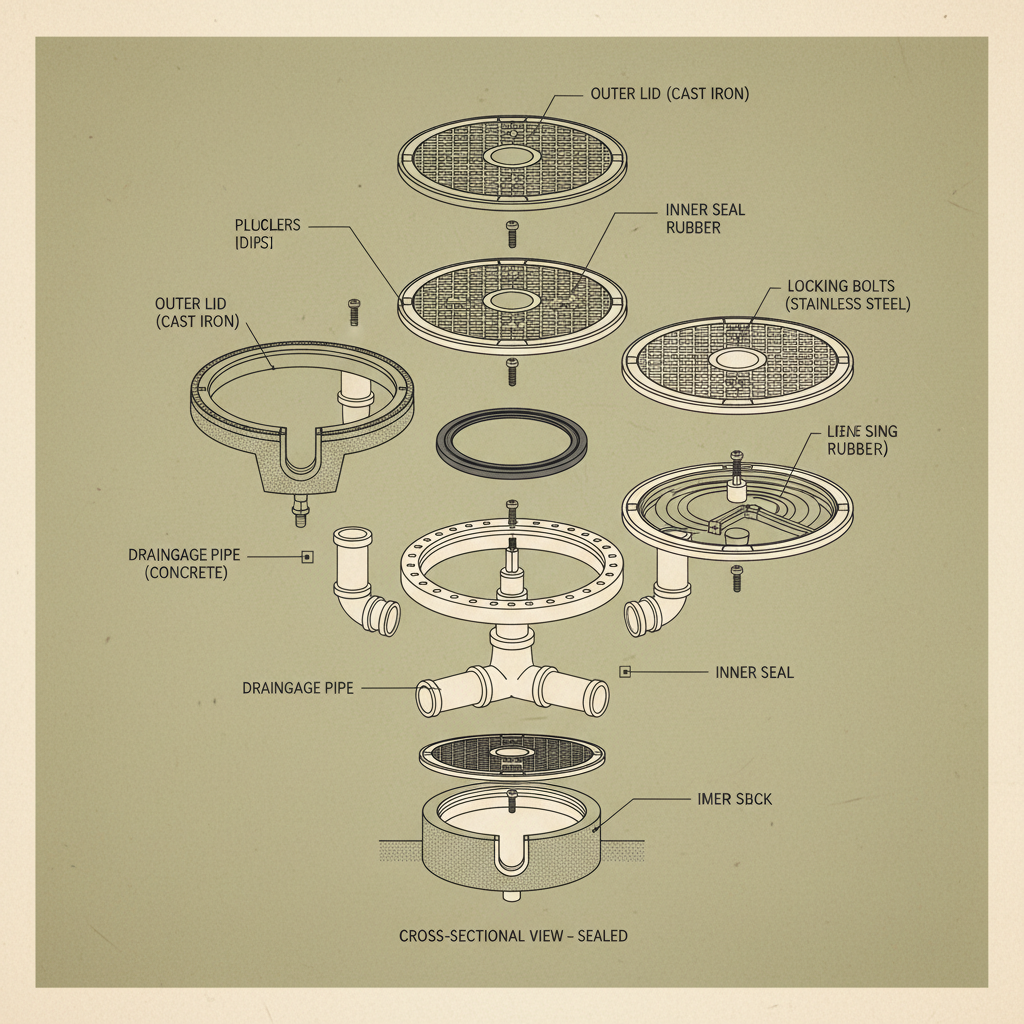

Innovations in Sealed Manhole Covers and Prefabrication Challenges

Industry Trends & Design Pitfalls

Innovations in Sealed Manhole Covers and Prefabrication Challenges

The big push right now is for lighter weight, easier installation. Everyone wants to reduce man-hours, and these composite covers definitely help. But here’s where it gets tricky. They’re strong, sure, but they behave differently under load than cast iron. You can't just swap dimensions one-to-one. And strangely enough, a lot of the drawings I get still assume cast iron properties. It's like they haven't even bothered to update.

To be honest, the biggest pitfall I see is over-reliance on lab testing. Load tests in a controlled environment are fine, but they don’t account for the real-world: shifting ground, vibration from traffic, the sheer abuse these things take. I encountered this at a water treatment plant in Tianjin last time. They’d specified a cover based solely on its static load rating. Didn’t consider the dynamic load from the pumps… the cover cracked within a month.

Material Science on the Ground

Let's talk materials. Polymer concrete is the dominant player, but there’s a lot of variation within polymer concrete. Some are resin-based, others use cementitious binders. The resin ones are smoother, more resistant to chemicals, but can be more brittle. The cementitious ones are cheaper, more impact-resistant, but absorb more water. It’s a trade-off, always. You really need to feel the material, understand its characteristics. Smell it even. Sounds weird, I know. But you get a sense of the quality that way.

We're also seeing some fiberglass reinforced polymer (FRP) covers coming onto the market. These are even lighter, super corrosion-resistant. But they can be more susceptible to point loads – if someone drops something heavy right on the edge. It's a bit of a gamble.

Then there's the rubber seals, obviously. That's critical. EPDM is the go-to, but you get different grades of EPDM. Cheaper EPDM degrades faster, especially with UV exposure. You have to specify a UV-stabilized grade. Otherwise, you're replacing seals every year.

Real-World Testing & Application

Lab tests are useful, but I rely on what I see happening in the field. We do impact testing, but not with a calibrated hammer. We drop weights. We run over them with forklifts (empty, of course… usually). We try to break them, basically. It's crude, but it gives you a better sense of how they'll hold up under real-world abuse.

Application matters, too. A manhole cover in a pedestrian zone has different requirements than one in a busy industrial area. We see a lot of covers used in wastewater treatment plants. Those need to be seriously corrosion-resistant. We’ve started doing salt spray tests – just leaving them in a salt chamber for weeks and seeing what happens. It's messy, but effective.

You'd be surprised how often people try to use the wrong cover for the job. Last year, I had a site foreman trying to use a light-duty cover for a heavy vehicle zone. I told him, he argued, I showed him the specs, he still tried to argue. Later… Forget it, I won't mention it.

Advantages, Disadvantages, and Customization

The advantages of these newer materials are obvious: lighter weight, corrosion resistance, lower life-cycle cost. But they're not perfect. They're more expensive upfront, and some can be more susceptible to damage from sharp impacts. They're also harder to repair. You can weld cast iron, but you can't weld polymer concrete.

Customization is definitely possible. We can adjust the dimensions, the load rating, the color (though no one ever asks for that). We had a client in Singapore who wanted a cover with a custom logo molded into the surface. That was a pain, but we managed it. They were insistent on a very specific shade of blue.

Sealed Manhole Cover Performance Metrics


Customer Story: Shenzhen & The Debacle

Last month, a small boss in Shenzhen who makes smart home devices – real pushy guy – insisted on changing the interface to for everything, including the manhole cover access points. His logic? "It's the future! It's reversible! It's convenient!" I tried to explain that we’re talking about a heavy cover that needs to be securely locked down, not a phone charger. But he wouldn't listen.

He ordered a batch with custom locking mechanisms. They failed spectacularly during installation. The mechanism just wasn’t strong enough to withstand the torque. The whole thing had to be scrapped. Cost him a fortune. He wasn’t happy. I felt bad, but also… I saw it coming.

Key Performance Indicators

We track a few key things. Obviously, load capacity is paramount. But we also look at corrosion rates, seal integrity, and installation time. And crucially, we ask the installers for feedback. They're the ones actually dealing with the things day in and day out.

Here's a rough breakdown of what we’re looking for:

Key Performance Indicators for Sealed Manhole Covers

KPI Category Measurement Method Target Value Acceptable Range
Load Capacity Static & Dynamic Load Testing ≥ 10 kN 8-12 kN
Corrosion Resistance Salt Spray Testing (hours) ≥ 1000 hours 700-1500 hours
Seal Integrity Hydrostatic Pressure Testing No Leakage @ 0.5 bar Minor seepage acceptable
Installation Time Time Study on Site ≤ 30 minutes 20-45 minutes
Material Density Laboratory Measurement 1.8 - 2.2 g/cm³ 1.6-2.4 g/cm³
Worker Feedback On-site Surveys & Interviews Positive Sentiment Neutral to positive

FAQS

What’s the typical lifespan of a composite sealed manhole cover?

Honestly, it depends heavily on the environment and load. But a well-maintained composite cover should easily last 20-30 years. That's a big improvement over cast iron, which can corrode and crack much faster, especially in aggressive environments. Key is the UV protection in the resin, and the quality of the seal. We've seen some installations still going strong after 35 years, but those are the exceptions, not the rule.

How do composite covers handle heavy vehicle traffic?

That’s the big question, right? We specify different grades of composite for different load classes. For light traffic – pedestrian zones, bike paths – a standard composite cover is fine. For heavy vehicle traffic – truck routes, industrial areas – you need a higher-strength composite, often with a steel or iron frame for added support. It's all about selecting the right material for the application.

Are composite manhole covers more expensive than cast iron?

Upfront, yes, they’re usually more expensive. But consider the long-term costs. Composite covers are lighter, which reduces installation costs and labor. They're corrosion-resistant, which means lower maintenance and replacement costs. And they won't get stolen for scrap metal, which is a surprisingly common problem with cast iron. When you factor all that in, the total cost of ownership is often lower with composite.

What happens if a composite cover gets damaged? Can it be repaired?

That’s a tough one. Unlike cast iron, you can’t really weld composite. Minor scratches and chips can sometimes be patched with epoxy resin, but for significant damage – cracks, breaks – the cover usually needs to be replaced. It's a limitation, definitely. We’re looking into more advanced repair techniques, but nothing solid yet.

What certifications do I need to look for when purchasing these?

Look for EN 124 certification – that's the European standard for manhole covers. Also, make sure the manufacturer has ISO 9001 certification – that demonstrates a commitment to quality management. And if you’re dealing with wastewater applications, check for certifications related to corrosion resistance and chemical compatibility.

Can I customize the size and shape of a composite manhole cover?

Yes, absolutely. Most manufacturers offer custom sizing and shaping. We've done everything from round and square covers to oval and even triangular ones. The lead time will be longer, and there’s usually a minimum order quantity, but it’s definitely possible. Just be prepared to pay a premium.

Conclusion

So, where does all this leave us? Sealed manhole covers, whether composite, cast iron, or something else entirely, are a critical part of our infrastructure. They’re often overlooked, but they play a vital role in protecting public health and safety. The industry is shifting towards lighter, more durable materials, and customization is becoming increasingly important. But ultimately, the success of any manhole cover depends on its ability to withstand the rigors of the real world.

Ultimately, whether this thing works or not, the worker will know the moment he tightens the screw. That's the truth of it. We can run all the tests we want, design the most sophisticated materials, but if it doesn’t feel solid and secure underfoot, it’s not good enough. And that’s what keeps me going back to the construction sites, getting my boots dirty, and listening to what the guys on the ground have to say.


David Miller

David Miller

David Miller is a seasoned Sales Engineer at Hebei Yongqian Trading Co., Ltd., specializing in valve and pipe fitting solutions. With over 8 years of experience in the fluid systems industry, David possesses a deep understanding of material science and application engineering. He works closely with clients in municipal water
Previous Essential Guide to Septic Tank Manhole Cover Selection and Implementation
Next Exploring the Importance of a Reliable Manhole Cover Hook for Infrastructure Maintenance